
December 2025
Dear Friends,
This year revealed how far this administration is willing to go in undermining public health. The White House refused to recognize World AIDS Day. Global and domestic HIV, TB, and HCV programs were directly threatened, and many were terminated. Senior CDC leaders resigned rather than carry out political firings or oversee the degradation of national vaccine guidance. And in August, a vigilante encouraged by political rhetoric fired nearly 500 rounds into the CDC campus in Atlanta and killed a police officer. The President has still not publicly acknowledged the attack.
At TAG, none of this is theoretical. Our board members and staff are experiencing the consequences of this political moment directly, in their communities and in their work. Their experiences have helped shape TAG’s responses throughout the year and in the months ahead.
Two reflections in particular, from Board President Ivy Kwan Arce and Board Secretary Dr. Stefan Goldberg, show clearly what we are facing and why TAG’s work must continue. Both bring decades of frontline understanding and lived experience to their roles.
Ivy’s perspective
Two weeks before World AIDS Day, during an ACT UP meeting, I felt a rising rage. In the middle of this administration’s dismantling of healthcare, we had not mounted a campaign to confront it. The only way to breathe through the suffocation was to organize fast.
In that short window, our team built a plan and moved through shifting directions and impossible timelines. The urgency was clarifying. We wanted to mark this moment so our movement can later see exactly where we stood in 2025.
The last 24 hours before December 1 brought no sleep — only revisions, lists, and the toll this work takes on my family. We have to do this work for the ones we have lost, even when it starts with getting on the road at 4 a.m. for wheat pasting. When U.S. policy freezes aid, undermines science, or disrupts treatment access, the result is predictable and preventable loss of life, unfolding now at a massive scale.
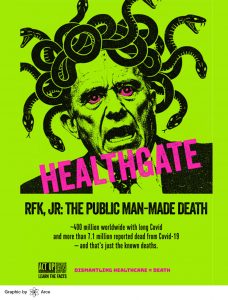 On World AIDS Day, I spoke at the rebuilt World Trade Center on a panel about long-term survival and aging. Afterward, I rushed downtown to the NYC AIDS Memorial for the march to Stonewall, the die-in, and the Reading of the Names across multiple sites. At 7 PM, I facilitated the ACT UP Monday meeting, closing a full day of remembrance, grief, and action.
Later that night, a World AIDS Day tribute shattered me. It was written by the wife of my longtime friend Andrew, honoring his father, Allan, who had lived with HIV for 30 years before passing last year. I had never known. Andrew was standing next to me when I received my HIV test results 35 years ago, yet he carried this family history in silence.
You never know how deep the challenges and stigma run, even among people you love and trust. I dedicated my World AIDS Day actions to Allan and George.
Stefan’s perspective
Bullet holes remain visible in the front of the CVS across from the CDC campus, where a vigilante fired nearly 500 rounds on August 8. Seeing them brought back a memory I never expected to revisit in the United States. The last time I saw anything like that was in Santiago, Chile, in 1986, in the shadow of a dictatorship. It is staggering to see this country joining a list of what many of us once believed were relics of another era.
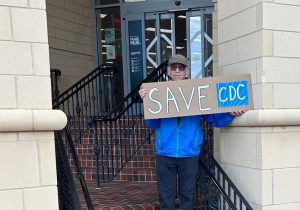 Rallies at and near that intersection have gone on for months. Retired and fired CDC staff gather there weekly to show support for current CDC staff and their work. Morale at CDC is the lowest I have seen in my decades in public health. Science has never been this politicized. The danger is not only the attack itself. It is the refusal of leadership to acknowledge it.
This summer, senior CDC leaders resigned to protect their director after she resisted pressure from HHS to fire staff based on political ideology. Their resignations were meant to prevent her removal. The President has not commented on any of this, nor on the attack that killed DeKalb County Police Officer David Rose as he selflessly defended this federal agency.
I spent my career in TB control and research at Seattle’s TB program and at CDC in Atlanta, believing that evidence would always guide public health. This year proved how fragile that assumption is.
Why TAG’s work must continue
TAG was founded on the belief that science, policy, and truth must be protected, especially when political forces seek to distort or suppress them.
This year, TAG worked to protect global and domestic HIV, TB, and hepatitis programs from unprecedented threats. We pushed back against political interference in scientific agencies. We worked across coalitions to ensure that decades of public health progress would not be undone. We insisted on evidence, accountability, and equity wherever decisions affect people’s lives.
These stories reflect a broader truth. Our board members and our staff have weathered a year defined by cuts, backward progress, and direct attacks on the core of our work, our mission, and our values. Together, they have held the line to protect HIV, TB, and hepatitis C programs and to defend the basic human right to science and medicine.
Our board, including Ivy, Stefan, and others, has been deeply engaged in guiding this work. They see firsthand the dangers of this moment. They understand what is at stake, and they are committed to ensuring that TAG remains a strong and independent voice for science and justice.
They are asking for your partnership.
Help TAG reach $80,000 by December 31
To continue this work in 2026, TAG needs your support.
Your tax-deductible donation strengthens TAG’s ability to defend scientific integrity, protect vital global health programs, and hold public institutions accountable when political forces attempt to silence them.
On behalf of the entire TAG board and staff we ask you to make a donation today and help us reach our goal of $80,000 by December 31. This is not a normal moment. It requires clarity, courage, and commitment. TAG is here, and with your support, we will continue to meet this moment head-on.
With resolve,
TAG’s Board and Staff
Ivy Kwan Arce is a 2021 RIAA honoree, HIV positive long-term survivor, and advocate for women and affected communities. Dr. Stefan Goldberg is a retired CDC TB researcher and pulmonologist who lives in Atlanta, Georgia, and Boulder, Colorado.