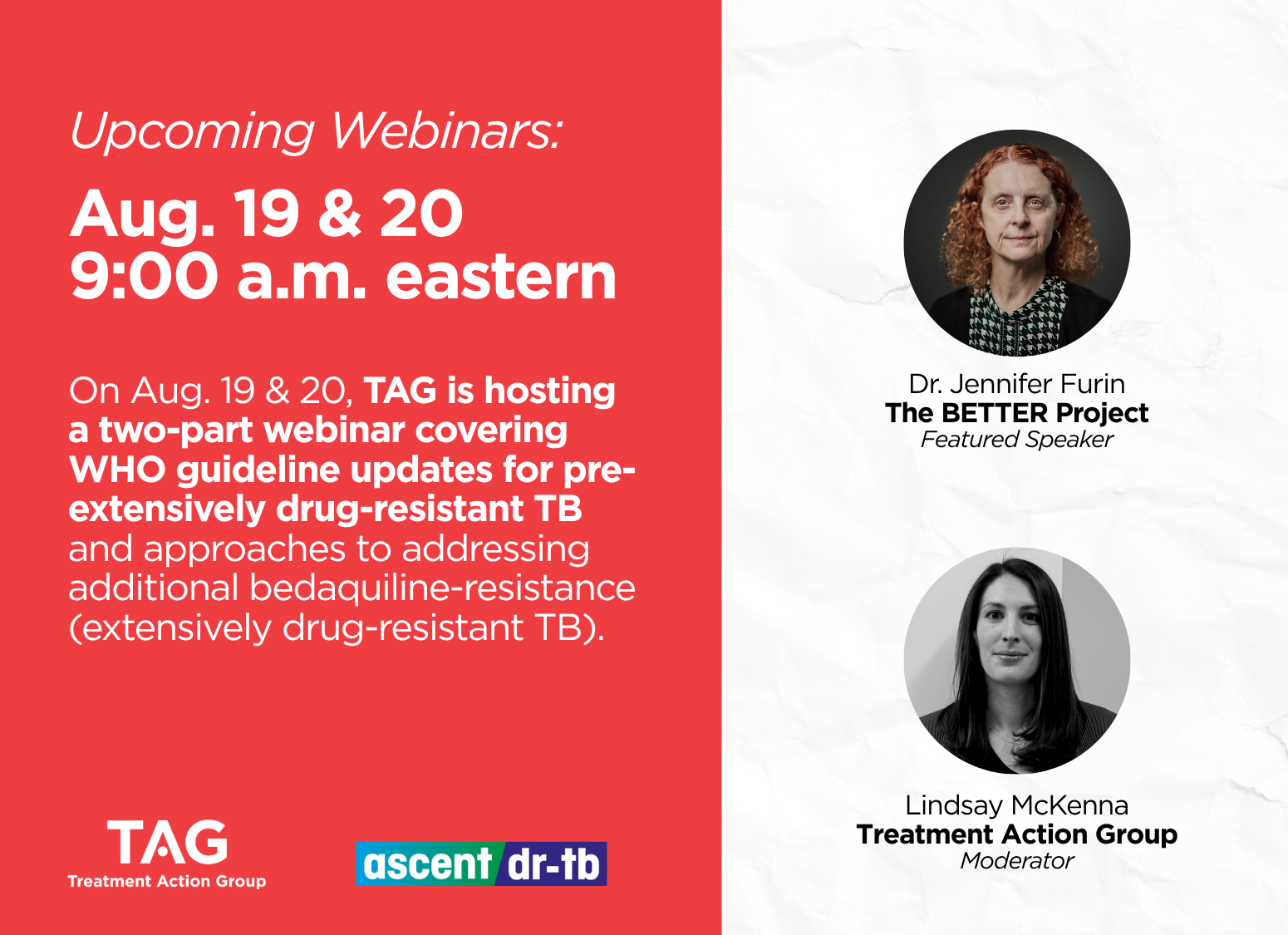
On August 19th & 20th, TAG is hosting a two-part webinar covering WHO guidelines updates for pre-extensively drug-resistant TB and approaches to addressing additional bedaquiline-resistance (extensively drug-resistant TB).
Part I will focus on the WHO guidelines, taking a close look at new WHO recommendations for treating people with pre-XDR-TB now stratified by severity of disease, and reviewing treatment options available to people that are ineligible for pretomanid-containing regimens. Part II will focus on how to address extensively drug-resistant TB, including treatment guidelines, compassionate use, and palliative care.
The webinars will also serve as the official launching point for new community materials, including The InSIDE Story on SIDE Effects: What You Need to Know from Head to Toe, a collection of materials designed to support community engagement in active drug safety monitoring and management (ADSM) efforts.
This double-header is the next installment in TAG’s series of community training on DR-TB supported by the Unitaid-funded ASCENT DR-TB Project. You can access recordings of past webinars in this series, including “What TB Treatment Advocates Need to Know about ADSM/PV” and “Using Digital Storytelling and AI for Active Drug Safety Monitoring in TB Care” here.
Part I: WHO Guidelines Updates for Treating Pre-Extensively Drug-Resistant TB (pre-XDR-TB): A Shift Away from the One-Size-Fits-All approach
Date: August 19, 2026 @ 09:00-10:00 AM EST
Registration Link: https://us06web.zoom.us/meeting/register/ydiXDfqrRFmI8BpNb0XwWA
Background
The World Health Organization (WHO) recently updated its guidance for the treatment of pre-extensively drug-resistant tuberculosis (pre-XDR-TB) — rifampicin-resistant/multidrug-resistant tuberculosis (RR-/MDR-TB) that is also resistant to fluoroquinolones. These new WHO treatment recommendations mark an important step away from one-size-fits-all approaches by ensuring people with more severe disease and fluoroquinolone resistance receive adequate treatment.
Under the new recommendations:
- Adults and adolescents (14 years and older) with non-severe pre-XDR-TB should receive the six-month BPaL regimen (bedaquiline, pretomanid, and linezolid), while those with severe disease should receive BPaLC (adding clofazimine).
- Children and adolescents younger than 14 years with non-severe pre-XDR-TB should receive the BDLC regimen (bedaquiline, delamanid, linezolid, and clofazimine), while those with severe disease should receive longer individualized regimens.
This updated guidance is informed by data from pivotal clinical trials, including TB-PRACTECAL led by Médecins Sans Frontières (MSF) and endTB-Q led by Partners In Health (PIH), and data from a prospective cohort study conducted in Belarus and Uzbekistan.
Community organizations can play a critical role in promoting understanding of the new guidance, supporting treatment literacy, monitoring implementation, and advocating for equitable access to optimized regimens.
The webinar will break down the updated WHO recommendations for pre-XDR-TB treatment and their implications for patients, healthcare providers and TB programs, and review treatment options available to people that are ineligible for pretomanid-containing regimens.
Expected Outcomes
By the end of the webinar, participants will:
- Understand what has changed in the WHO recommendations for treating pre-XDR-TB
- Review WHO recommendations for people with RR-/MDR-TB and pre-XDR-TB that are ineligible for pretomanid-containing regimens (e.g., children, pregnant women, people with recent exposure to DR-TB treatment)
- Review the evidence that informed the updated guidance
- Understand the distinction between severe and non-severe disease and how it’s diagnosed and influences treatment selection
- Discuss the implications of the recommendations for adults, adolescents, and children
- Explore potential implementation challenges
- Identify priorities for community advocacy to support rapid and equitable adoption of the updated recommendations.
Part II: Addressing Extensively Drug-Resistant TB: Treatment Guidelines, Compassionate Use, and Palliative Care
Date: August 20 2026 @ 09:00-10:00 AM EST
Registration Link: https://us06web.zoom.us/meeting/register/D9rLevRZSte5lA4cNev5cg
Background
People with extensively drug-resistant TB (XDR-TB) – rifampicin/multidrug-resistant TB with additional resistance to the fluoroquinolones AND bedaquiline or linezolid– have few treatment options. Under current WHO guidance people with XDR-TB are treated with longer individualized regimens comprised of group B and C drugs, including those administered by injection or intravenously. Treatment outcomes are often poor with success rates for people with XDR-TB much lower than for people with less extensive forms of drug-resistance.
This webinar will cover current best practices for the treatment and care of people with XDR-TB, including drug-susceptibility testing, regimen construction, pre-approval access to investigational drugs, and palliative care.
Expected Outcomes
By the end of the webinar, participants will:
- Review best practices for treating XDR-TB
- Identify knowledge and evidence gaps
- Learn about pre-approval access and palliative care
- Understand program and practice gaps and barriers to treating XDR-TB
- Discuss advocacy priorities and strategies for addressing the unmet needs of people with XDR-TB
Moderator: Lindsay McKenna, Treatment Action Group
Featured Speaker: Dr. Jennifer Furin, The BETTER Project
Jennifer Furin, MD., PhD, is an infectious diseases doctor and medical anthropologist with 30 years of experience working on drug-resistant tuberculosis (DR-TB). She is the current chair of The BETTER Project, a community of practice that is Building Experience Treating TB with Expanded Resistance. She is also an Associate Professor of Infectious Diseases at Case Western Reserve University. She specializes in the care of children, pregnant women, and people with highly resistant strains of TB.