
Download:
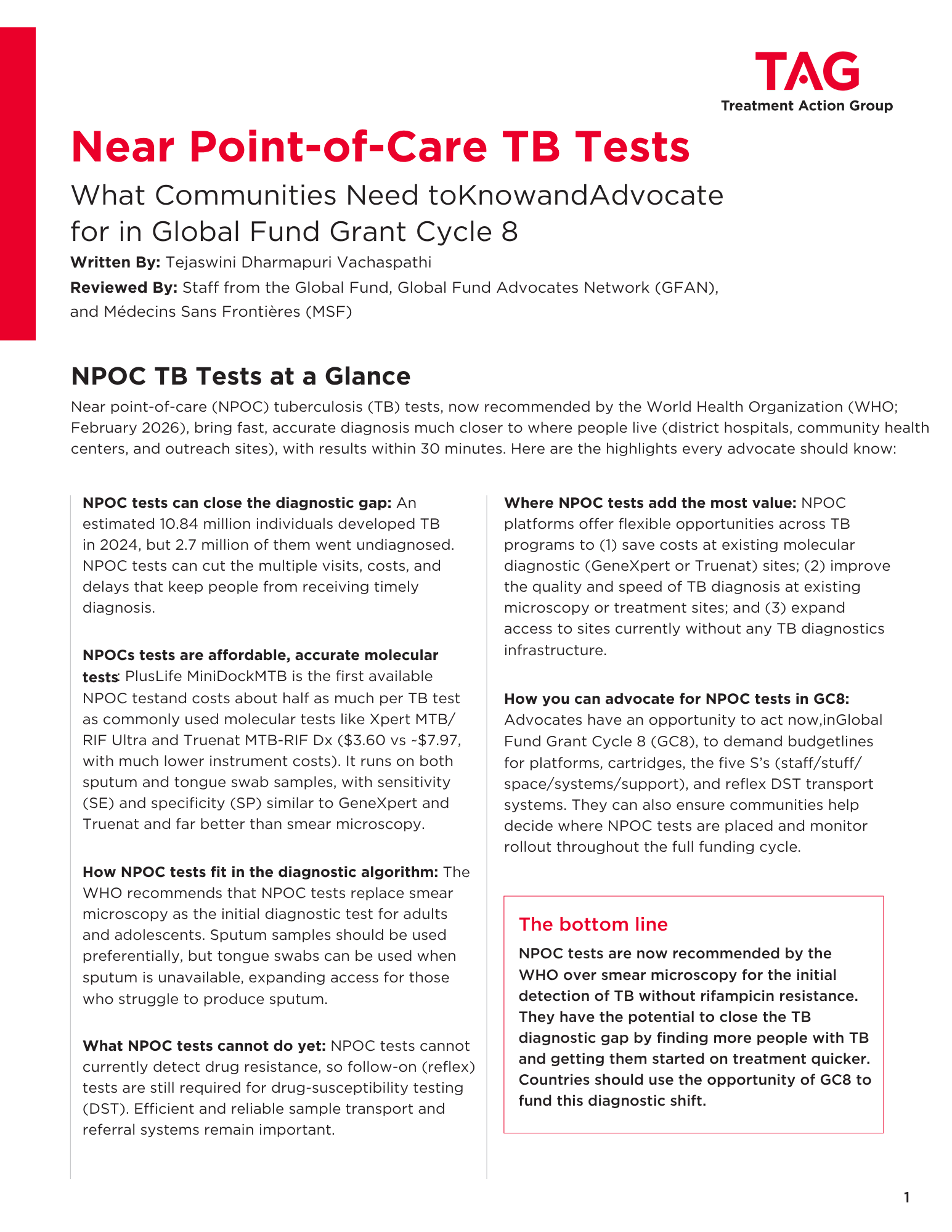
The world of tuberculosis (TB) testing is changing for the better and Treatment Action Group (TAG) is proud to release our latest factsheet on near point-of-care (NPOC) TB tests to help communities and advocates make the most of this moment.
With the Global Fund’s Grant Cycle 8 (GC8) now open, this factsheet comes at a critical time for countries preparing funding requests, cost roadmaps, and advocacy strategies to secure NPOC rollout. GC8 is a critical opportunity to shape how new TB diagnostics are financed and deployed over the next grant cycle.
TB remains the world’s leading infectious disease killer, and a persistent diagnostic gap means millions go undetected every year. In 2024 alone, an estimated 2.7 million of the 10.8 million people who developed TB went undiagnosed. Current TB diagnostic tests require laboratories, stable electricity, and trained staff, creating barriers to care for people in rural and primary care settings.
Recommended by the World Health Organization (WHO) earlier this year, these new portable, battery-powered molecular tests deliver accurate results in under 30 minutes at district hospitals, community health centers, and outreach sites, bringing testing closer to where people seek care.
The first available NPOC test, the PlusLife MiniDock MTB, costs approximately $3.60 per test, roughly half the cost of currently used molecular tests, and can use tongue swabs when sputum samples are unavailable, expanding access for populations who struggle to produce sputum.
The Global Fund to Fight AIDS, TB, and Malaria’s Grant Cycle 8 represents a once-in-three-years opportunity to secure financing for NPOC rollout. Countries that develop ambitious, cost roadmaps will be better positioned to access this funding, while those that delay risk missing out.
TAG’s new factsheet gives advocates the tools needed to succeed: clear budget language, use case illustrations, advocacy questions for country dialogues, and a step-by-step timeline spanning the full funding cycle.
Whether your priority is replacing outdated smear microscopy, expanding molecular testing at existing sites, or bringing TB diagnostics to under-resourced communities, this guide will help you make sense of it all.
The technology is ready. The funding is available. The time to act is now.
Other Resources
1) Médecins Sans Frontières (MSF). Near Point-of-Care Tests for Tuberculosis: What You Need to Know. Fact Sheet. Paris: MSF; February 2026. Available at: https://www.msf.org/report-near-point-care-tests-tuberculosis.
2) World Health Organization (WHO). Near Point-of-Care Tests, Tongue Swabs, and Sputum Pooling for TB. Geneva: WHO Global TB Programme; 2026. Available at: https://www.who.int/teams/global-programme-on-tuberculosis-and-lung-health/diagnosis-treatment/npoc-tongue-swabs-and-sputum-pooling-for-tb.
3) SamiNAPP. MiniDock Cost Comparison Tool: Cost Analysis for Presumptive TB Testing Using LCaNAAT and NPOC Molecular Tests. Online tool. Available at: https://saminap.shinyapps.io/minidock/.
4) Diagnostics Equity Consortium. New Near Point of Care TB Tests. March 2026. Available at: https://tinyurl.com/nPOCs