
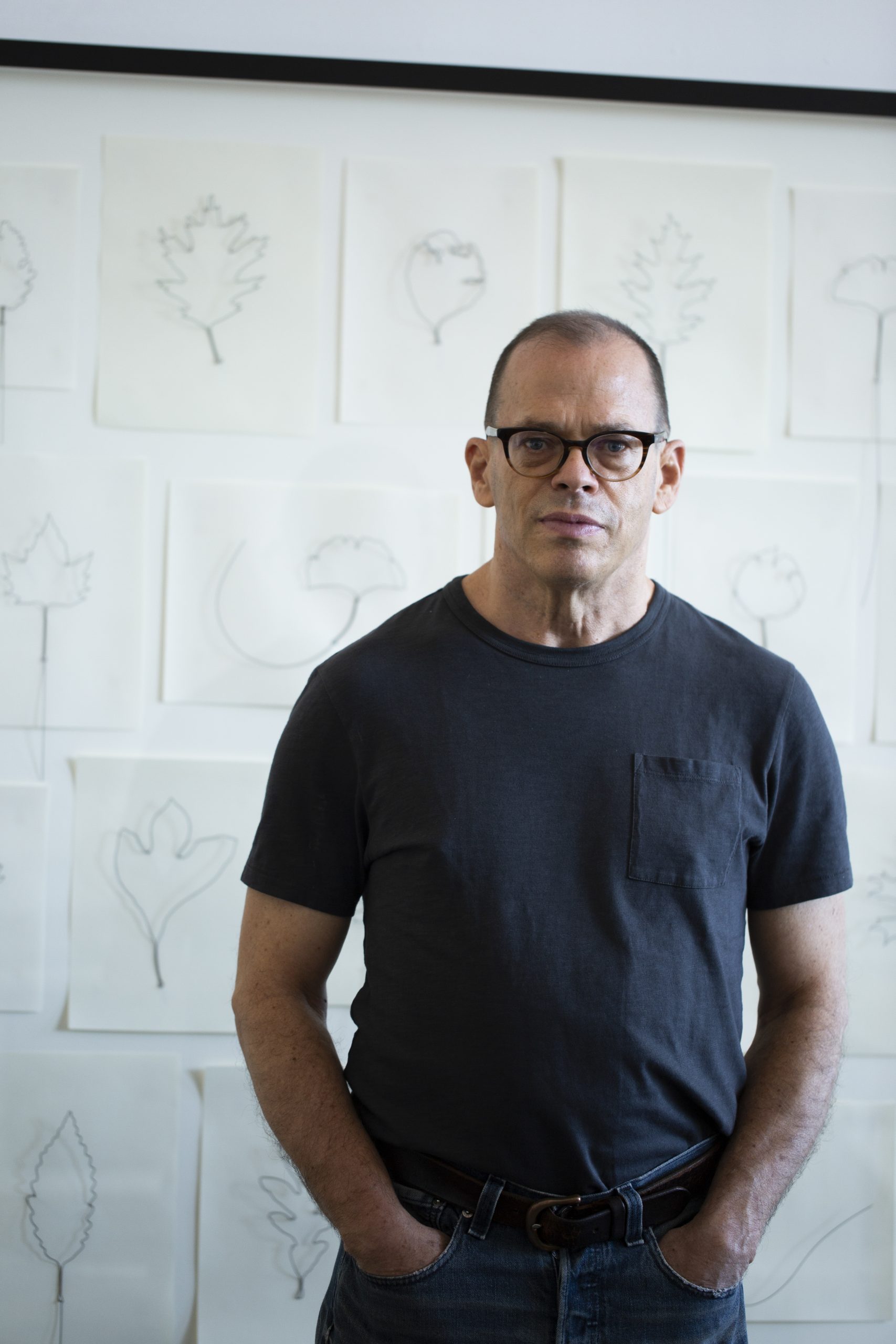
Eric Rhein’s work—in a variety of media—chronicles his experience and travels, both geographic and mystic; his childhood in the Appalachian Mountains and New York’s Hudson Valley, and his more than three decades living with HIV.
Arriving in New York City in 1980, 18-year-old Rhein became a part of the East Village arts scene. His first New York works, butterfly puppets constructed for George Balanchine, sparked an interest in the use of linear elements—a formal theme which recurs in his work.
Eric explores themes of vulnerability, resilience and transcendence. In 1996, the year protease inhibitors restored Rhein’s physical vitality, he began his ongoing series, Leaves, honoring the lives of nearly 300 individuals he knew who died of complications from AIDS. Leaves continues to evolve and be shown internationally. Art historian Robert Atkins wrote, “Art has always played a role in coming to terms with collective tragedy, and the role of an artist has frequently been to bear witness. Surely an art of memory like Eric Rhein’s can help harmonize our views by suggesting that honoring the past is one way to live more fully in the present.”
The activist orientation of his work follows in the footsteps of his Uncle Lige Clarke (1942-1975), a pioneer in the Gay Rights movement of the 1960’s and 70’s.
Rhein’s monograph-memoir Eric Rhein – Lifelines features intimate photographs: self-portraits and images of friends and lovers as a personal response to the AIDS crisis.
Rhein received his BFA and MFA from SVA. International exhibitions include the Pera Museum, Istanbul; 21er Haus Museum of Contemporary Art, Vienna; American Embassies in Austria, Cameroon, Greece, and Malta; Addison Gallery of American Art; the Leslie-Lohman Museum; Lincoln Center, Artists Space; Art in General; Sculpture Center; White Columns; Bronx Museum of the Arts; and the Yale University Art Gallery. Reviews of Rhein’s work have appeared in numerous publications, including The New York Times, Art News, and Art in America. Grants and fellowships include the Pollock/Krasner Foundation, Art Matters, and MacDowell.
Eric Rhein is included in the Smithsonian Archives of American Art’s “Visual Arts and the AIDS Epidemic: An Oral History Project.” in which participants are interviewed in-depth, creating a comprehensive review of their life and work. For his art and activism, Eric received the 2017 Visual AIDS Vanguard Award.