Poetry can be a powerful public health tool. In a recently written poem, LAT CAB member Bakyt Myrzaliev speaks about the trials and tribulations of tuberculosis treatment – writing passionately and inquisitively about side effects, the high burden of countless pills, and ultimately calling for investments into newer forms of treatment.
Treatment Action Group (TAG) and the African Community Advisory Board (AfroCAB) formed the Long-Acting Technologies Community Advisory Board (LAT CAB) to implement meaningful, equitable solutions and research to serve communities that need them the most. LAT CAB is a dedicated community body that advances LAT research and uptake under the Unitaid-funded LONGEVITY project.
Every morning, I look at my pills and ask myself the same question:
Why are there so many?
White pills, yellow pills, pink pills, big pills, bitter pills. Some to be taken before food, others after food.
Some make me feel sick. Some make me weak. Sometimes it feels like I am not only treating tuberculosis, but fighting against my whole life, which has become too heavy.
The doctor told me: “You must not stop treatment.”
I understand.
I want to live. I want to get better. I want to work again, play with my children, leave my house without fear, and stop worrying that someone will find out about my diagnosis.
But why does it take so long?
Weeks pass. Then months.
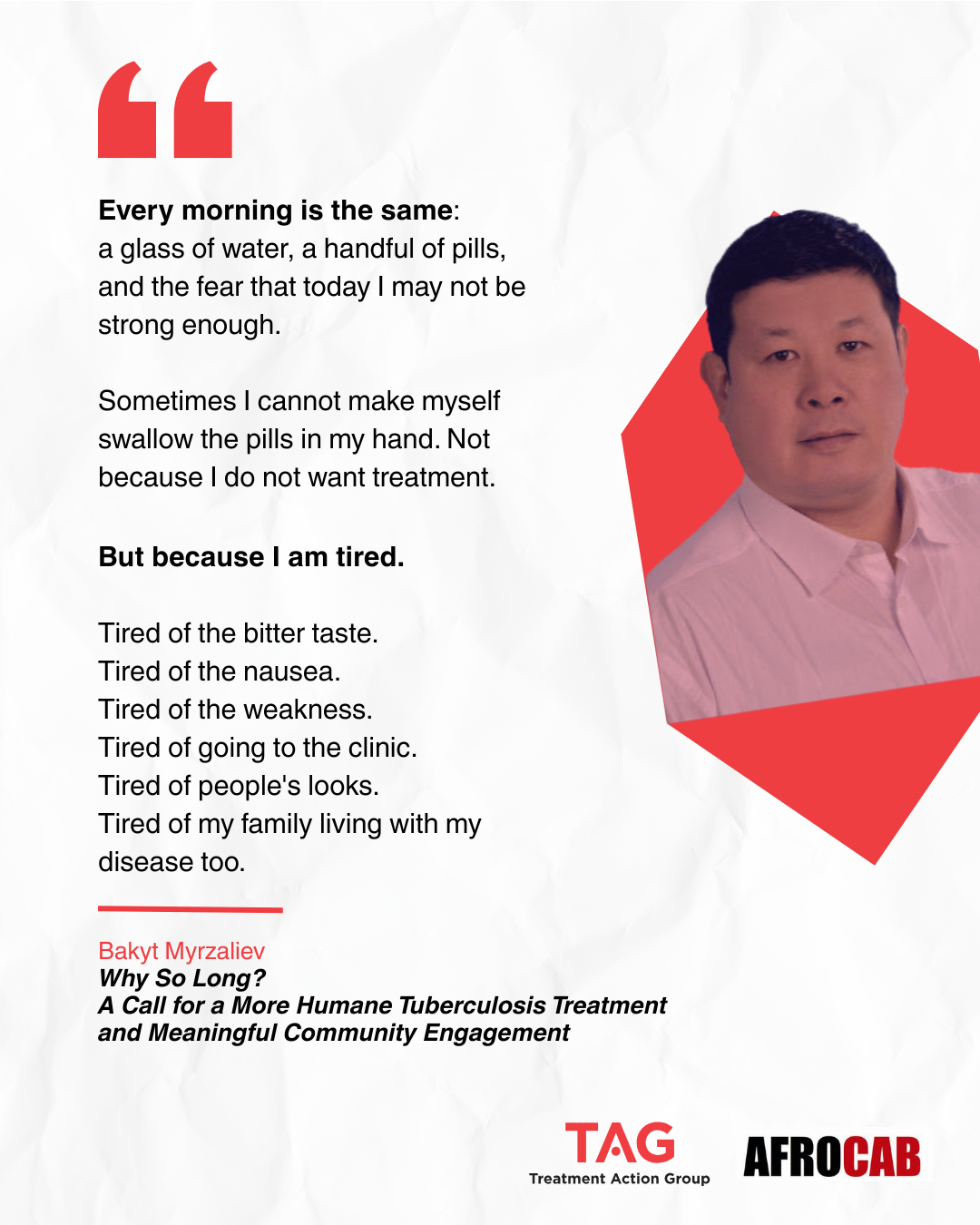
Every morning is the same: a glass of water, a handful of pills, and the fear that today I may not be strong enough. Sometimes I cannot make myself swallow the pills in my hand. Not because I do not want treatment. But because I am tired.
Tired of the bitter taste.
Tired of the nausea.
Tired of the weakness.
Tired of going to the clinic.
Tired of people’s looks.
Tired of my family living with my disease too.
One day I hid the pills in a drawer. I did not throw them away. I just hid them. I wanted to feel like a person for one day, not just like a patient.
They tell me that treatment saves lives. I believe that.
But sometimes the road to being saved feels so long and endless.
I know I am not alone.
Tuberculosis is one of the world’s deadliest infectious diseases. Every year, over 10 million people develop tuberculosis, and over one million people lose their lives to a disease that is preventable and curable.
In Kyrgyzstan, significant progress has been made in the fight against tuberculosis. The country has reduced tuberculosis incidence from 168 cases per 100,000 people in 2001 to approximately 56 cases per 100,000 in 2024 according to reports by the National Center for Phthisiology, and mortality has fallen dramatically. Yet tuberculosis still affects thousands of people and families, and drug-resistant tuberculosis remains a serious challenge requiring long, difficult treatment regimens.
Behind every statistic is a person:
A mother trying to care for her children while dealing with nausea from treatment.
A father unable to work because treatment has left him exhausted.
A young person who misses school, hides their diagnosis, and counts the months until treatment finally ends and they can regain their life.
For many of us, the hardest part of living with tuberculosis is not the disease itself.
It is the duration.
It is the pills that remind us we are sick.
It is trying to stay strong when treatment becomes part of every decision, every plan, and every hope for the future.
That is why innovation matters.
Scientists are working to develop long-acting therapies for tuberculosis that could one day reduce the burden of daily treatment. Long-acting medicines have already transformed care in other diseases, showing that treatment can be effective and less burdensome on the people who use it.
For some people, long-acting tuberculosis treatments sound like a scientific breakthrough.
For me, they sound like hope.
Hope that treatment can fit into, and not take over, my life.
Hope that fewer doses could mean fewer opportunities to miss treatment.
Hope that fewer clinic visits could reduce stigma and disruption.
Hope that people living with tuberculosis will no longer have to choose between enduring months of treatment and giving up.
But as researchers advance long-acting therapies, one lesson must not be forgotten:
Innovation succeeds when it is shaped by the people it is intended to serve.
People affected by tuberculosis are not merely beneficiaries of research. They are experts in the challenges of taking medicines every day, managing side effects, navigating stigma, and remaining engaged in care for months at a time. Their experiences can help researchers design long-acting therapies that are acceptable, accessible, and responsive to the needs of communities.
That is why global donors, governments, research institutions, pharmaceutical companies, and product developers must invest not only in the science of long-acting therapies, but also in meaningful community engagement.
Funding for community advisory boards, patient advocates, civil society organizations, and people with lived experience for community engagement should constitute an essential part of research and development—not an optional add-on.
If long-acting tuberculosis therapies are to fulfill their promise, people affected by tuberculosis must have a seat at the table from the earliest stages of development through clinical trials, implementation, and access planning. Their voices can help ensure that new technologies are designed for real lives, real communities, and real-world challenges.
The future of tuberculosis treatment should not be built without the communities who will use it.
It should be built with them.
Tuberculosis treatment has saved millions of lives.
But saving lives cannot and should not be our only goal.
We must also reduce suffering.
We must invest in treatments that are not only effective, but easier to take, complete, and live with.
And as we invest in the development of long-acting therapies, we must invest in the people whose lives depend on them. Global donors must not leave community engagement behind. Investing in community engagement and people with tuberculosis lived experience to work with researchers, inform innovation, participate in community advisory mechanisms, and shape access strategies is not charity—it is good science, good public health, and good stewardship of scarce resources to achieve the best possible outcomes.
People affected by tuberculosis deserve medicines designed around their lives. They also deserve a voice in designing the future of tuberculosis care.
Because the question is not only whether treatment works.
The question is whether we are willing to make treatment shorter, simpler, more dignified, and more humane.
And after all these years, people with tuberculosis deserve nothing less.